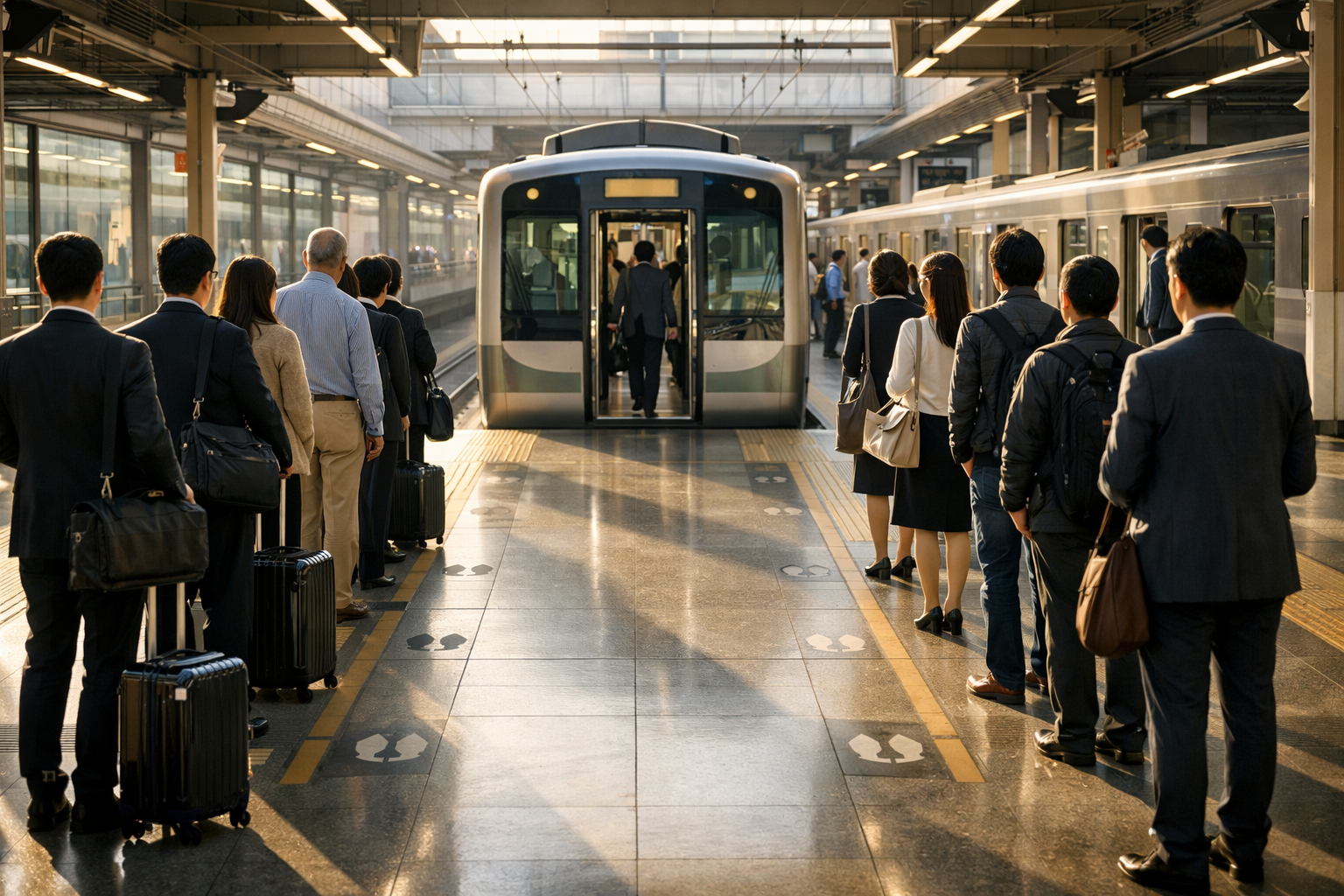
In Japan, you may find yourself standing in what looks like an empty patch of floor—only to realize you have accidentally stepped into a queue. The line may be marked by painted footprints, a small sign, numbered tiles, traffic cones, or nothing more than a quiet row of people who seem to know exactly where to stand.
Queueing in Japan is usually straightforward once you notice the signals. The challenge is that the signals can be subtle, and the “correct” place to wait changes depending on whether you are boarding a train, buying food, entering an elevator, catching a bus, or joining a festival crowd.
This is not about memorizing rigid rules. It is about learning how to read the situation. A little awareness will help you avoid awkward moments, move through crowded places more smoothly, and understand one of the everyday systems that makes busy Japanese cities feel surprisingly orderly.
Why queues in Japan can feel invisible to visitors
In many countries, a queue is obvious: people stand behind one another, often inside barriers or ropes. In Japan, lines are frequently organized through small environmental cues rather than large physical structures.
You might see:
- Footprints or arrows on the ground
- Numbered boarding positions on a train platform
- A narrow gap left beside a shop entrance
- A sign with Japanese text and a simple arrow
- People standing in a neat row several meters away from the actual door
- A staff member holding a small paddle or hand-written sign
The key is to pause briefly before joining a crowd. Look at where people are facing, where the front of the line appears to be, and whether there is a sign nearby. If you are unsure, a simple gesture toward the queue followed by “koko?” (“here?”) is usually enough to get help.
People do not expect visitors to know every local convention. They do tend to appreciate an effort not to push ahead, block an entrance, or create a second line beside an existing one.
Train platform queues: the most useful system to understand
For many travelers, train platforms are where Japanese queue etiquette becomes most noticeable. Major stations can be extremely busy, yet boarding often works with remarkable calm because passengers generally line up before the train arrives.
Follow the markings on the platform
On many urban rail platforms, especially in Tokyo, Osaka, Kyoto, and other large cities, the floor is marked to show where doors will open. These markings may include lines, arrows, train-car numbers, and symbols identifying the type of service.
Stand in the line beside the expected door position, rather than directly in front of it. When the train arrives, passengers get off first through the middle space, while the waiting lines enter afterward.
A practical pattern to remember is:
- Find the door markers for your train.
- Join the line behind other waiting passengers.
- Leave a clear path for people getting off.
- Board only after the exiting passengers have cleared the doorway.
- Move inward after entering so others can board.
This system is especially important during rush hour. Trying to board before passengers exit is one of the quickest ways to disrupt the flow—and it will make your own journey harder as well.
Check that you are queuing for the right train
A platform may serve more than one type of service. Local, rapid, express, and limited express trains can use the same track at different times, and their stopping patterns may differ significantly.
The line in front of you may be for a particular car, reserved seating section, women-only car during designated periods, or a train that is not the one you intend to take. Check the electronic departure board, platform signs, and train type before settling into a queue.
If you have a reserved seat on a long-distance train, look for the car number printed on your ticket or reservation details. Shinkansen platforms and many limited-express platforms have signs indicating where each car is expected to stop.
Do not assume one long line is always correct
At train doors, there are often two lines, one on each side of the doorway. This is intentional: the center remains clear for passengers leaving the train. Joining the middle because it looks shorter can create confusion.
On the other hand, at a small rural station, there may be no painted markings at all. In that case, simply wait behind the people already gathered near the door area. Smaller stations can be less formal, but the same basic principle applies: let people disembark before entering.
Escalator etiquette: follow the local pattern
The familiar advice that people stand on the left in Tokyo and the right in Osaka is broadly useful, but it should not be treated as a nationwide law. Escalator habits vary by city, station, and individual behavior. Signs in some places ask everyone to stand still rather than leaving one side open.
What matters most is observing the escalator immediately in front of you. If people are forming a standing lane and a passing lane, follow that pattern. If a station has signs asking riders not to walk, it is considerate to stand in the designated position and avoid rushing past others.
For travelers with large luggage, escalators are not always the easiest option. Elevators may be less obvious, but they are often more practical and safer for heavy suitcases. In large stations, look for elevator symbols on maps or ask staff for “eleveta.”
Elevators: wait first, enter second
Japanese elevator etiquette follows a simple rule that visitors will recognize from many places: allow passengers to exit before entering. What may feel different is how consistently people leave space in front of the doors, even when the elevator area is crowded.
When waiting, avoid standing directly against the doors. Make a small opening for people getting out. Once inside, move toward the back if possible rather than stopping immediately inside the doorway.
In office buildings, department stores, hospitals, and hotels, one person may stand near the control panel and hold the door open for others. There is no need to copy every gesture perfectly, but a quiet “arigato gozaimasu” is appropriate if someone keeps the door open for you.
When leaving, a short “sumimasen” (“excuse me”) is useful if you need to pass through a crowded elevator. It is one of the most versatile phrases a visitor can learn.
Restaurant lines: find the list before joining the crowd
Popular ramen shops, sushi counters, bakeries, cafés, and casual restaurants often have queues, particularly around lunch and dinner. But the process is not always as simple as standing at the door.
Before joining what looks like a line, check for:
- A clipboard or waiting list near the entrance
- A ticket machine outside the restaurant
- A touchscreen check-in kiosk
- A numbered ticket dispenser
- A sign asking customers to wait elsewhere
- A staff member directing guests
Some restaurants use a name list. Others ask you to take a numbered ticket and wait nearby until your number is called or appears on a screen. At a tiny restaurant, the queue may be along the side of the building rather than in front of the door, so that the entrance remains clear.
At ramen shops, buy your meal ticket before lining up if instructed
Many ramen shops use a vending machine called a shokkenki, literally a “meal-ticket machine.” You select and pay for your order before sitting down, then hand the ticket to staff when asked. In some shops, customers are expected to purchase a ticket before joining the line; in others, the machine is inside or staff will tell you when to use it.
Look at what the people ahead of you do and check for posted instructions. If the machine is entirely in Japanese, do not panic. Many have pictures, English options, or a limited menu that staff can help explain. It is also fine to point politely to a button and ask, “kore?” (“this one?”).
Do not linger at the table after a busy meal
In a quiet restaurant, there is usually no problem taking your time. In a very small, busy shop with a visible queue, however, it is courteous to finish, pay, and leave without turning the table into a long conversation spot.
This is particularly true at counter-style ramen, soba, udon, and curry shops designed for quick meals. It is not a judgment on tourists or a demand to eat at high speed. It is simply an acknowledgment that the next group has been waiting.
Convenience stores and supermarkets: look for the “one line” sign
Japanese convenience stores can be compact, busy, and deceptively efficient. At the checkout, the queue may be a single shared line that feeds several registers, rather than a separate line for each cashier.
Look for floor markings or a sign that says something like “Please line up here.” The end of the queue may be several steps away from the counters, leaving room for customers to finish paying and pack their items.
When it is your turn, wait for the cashier to indicate the register. In some stores, you will pay at a separate self-service payment machine after the cashier scans your purchases. This is becoming more common, although the exact process varies by chain and location.
At supermarkets, staff may place scanned goods into a basket, after which you move to a separate bagging counter. This keeps the register moving and gives customers room to pack their purchases. Do not assume that the cashier will bag everything for you.
Bus stops: the line may be farther back than expected
In many Japanese cities and towns, passengers queue at bus stops rather than crowding around the curb. The line may begin beside the shelter, behind a signpost, or along painted markings on the pavement.
When the bus arrives, let passengers get off before boarding. Then follow the people ahead of you. Depending on the city and bus company, you may board through the rear door and pay when exiting, or board through the front and pay when entering. The correct procedure is usually posted near the door, but it can vary.
On some local buses, passengers take a small numbered ticket when boarding. The number corresponds to a fare chart near the driver. In other areas, flat fares or contactless payment systems make the process simpler. Watch what local passengers do, and do not hesitate to show your transport card or cash to the driver if you need guidance.
At airport limousine buses and highway buses, there may be a more formal queue, a reservation counter, or assigned seating. Check the departure sign and ask staff before loading luggage or joining a line.
Taxi stands: use the first taxi in the designated line
Outside major stations, hotels, airports, and some tourist sites, taxis often wait in an organized line. There may be a separate passenger queue, with a staff member directing people to the next available vehicle.
Use the taxi at the front unless an attendant tells you otherwise. Walking past several taxis to choose one farther back can disrupt the system, especially when drivers are waiting in order.
If you need an accessible vehicle, a larger taxi, or a taxi that accepts a particular form of payment, ask the attendant if one is present. At smaller taxi stands, drivers may help direct you even if communication is limited.
Theme parks, museums, and popular attractions: queue rules can be highly specific
At major attractions, queues may involve timed entry, security checks, advance reservations, numbered tickets, or separate lines for people with different ticket types. Do not rely solely on the length of the line to decide where to stand.
Before joining, check the sign at the entrance for:
- Entry time or reservation requirements
- Bag-check instructions
- Separate lines for ticket holders and ticket buyers
- Timed-ticket collection points
- Restrictions on re-entry
- Guidance for strollers, wheelchairs, or large luggage
For seasonal events, exhibitions, and limited-time pop-ups, the queue may be managed by staff using numbered tickets or online reservations. In these situations, arriving early does not always guarantee entry; the event’s official instructions matter more than informal advice from social media.
If you are visiting an attraction that requires advance tickets, book through the attraction’s official site whenever possible and read the entry conditions carefully. A tour or ticket platform can be useful when it offers a product that genuinely matches your itinerary, but it should not replace checking the attraction’s current official rules.
Festival and shrine queues: know what people are waiting for
At shrines and temples, especially during New Year holidays or major local festivals, a long line may lead to worship, a special viewing area, a food stall, a ticket booth, or a restroom. Take a moment to identify its purpose before joining.
When a queue leads to the main worship area at a Shinto shrine, people may wait patiently for their turn to approach the offering box. There is usually no need to rush through the ritual. Watch the people ahead if you are unfamiliar with the sequence, and follow the posted guidance where available.
At food stalls, lines can form quickly and may blend into crowds. Try to identify the order point and the pickup point. In some cases, customers order, receive a number, then step aside until their food is ready. Blocking the front of the stall while waiting can make it difficult for the next customer to order.
What to do if you accidentally cut in line
It happens. You may not notice a floor marker, mistake the pickup line for the ordering line, or walk toward an open train door without seeing the queue to either side.
The best response is simple:
- Step back promptly.
- Say “sumimasen.”
- Use a small nod or bow.
- Join the correct end of the line.
There is no need for a long explanation. Quietly correcting yourself is usually enough. Most people understand that the system can be unfamiliar to visitors, particularly in crowded stations where the signs are easy to miss.
The same applies if someone points out the line to you. Treat it as useful help rather than criticism. A quick “arigato gozaimasu” will usually resolve the moment.
Small habits that make queueing easier in Japan
Keep your phone and ticket ready
At train gates, ticket machines, restaurant kiosks, and attraction entrances, having your phone, IC card, cash, or reservation QR code ready prevents delays. Avoid stopping suddenly at the front of a queue to search through a bag.
Keep luggage close to you
Large suitcases can block narrow platforms, station corridors, and restaurant entrances. Stand with your bags beside or in front of you, rather than leaving them behind where they create a tripping hazard or separate you from the line.
Do not save a large amount of space
Holding a place for one companion is sometimes tolerated in casual situations, but reserving space for an entire group can feel inconsiderate, especially in a popular restaurant line or crowded station queue. If your group is not ready, it is generally better to join when everyone has arrived.
Watch the person ahead, not only the signs
Signs are helpful, but real-time observation is often more useful. If everyone steps to one side, forms two lines, takes a ticket, or waits behind a particular marker, there is probably a reason. Following the local flow is often the fastest route through an unfamiliar system.
Plan Your Japan Trip
Before traveling, confirm your transport arrangements, accommodation details, and any timed-entry reservations. Keeping tickets and booking confirmations easy to access will help you move through stations, hotels, and attractions without delaying the queue.
The real skill is noticing the flow
Queueing in Japan is less about performing perfect etiquette and more about making space for other people. Leave room for passengers to exit, keep entrances clear, check whether a ticket is required, and take a few seconds to understand where a line begins.
Once you start noticing these patterns, they become surprisingly easy to read. The painted footprints at a station, the quiet row outside a noodle shop, and the small gap in front of an elevator are not random details. They are practical tools that help crowded places work.
And when in doubt, pause, look around, and follow the flow. In Japan, that small habit will take you a long way.
コメントを残す