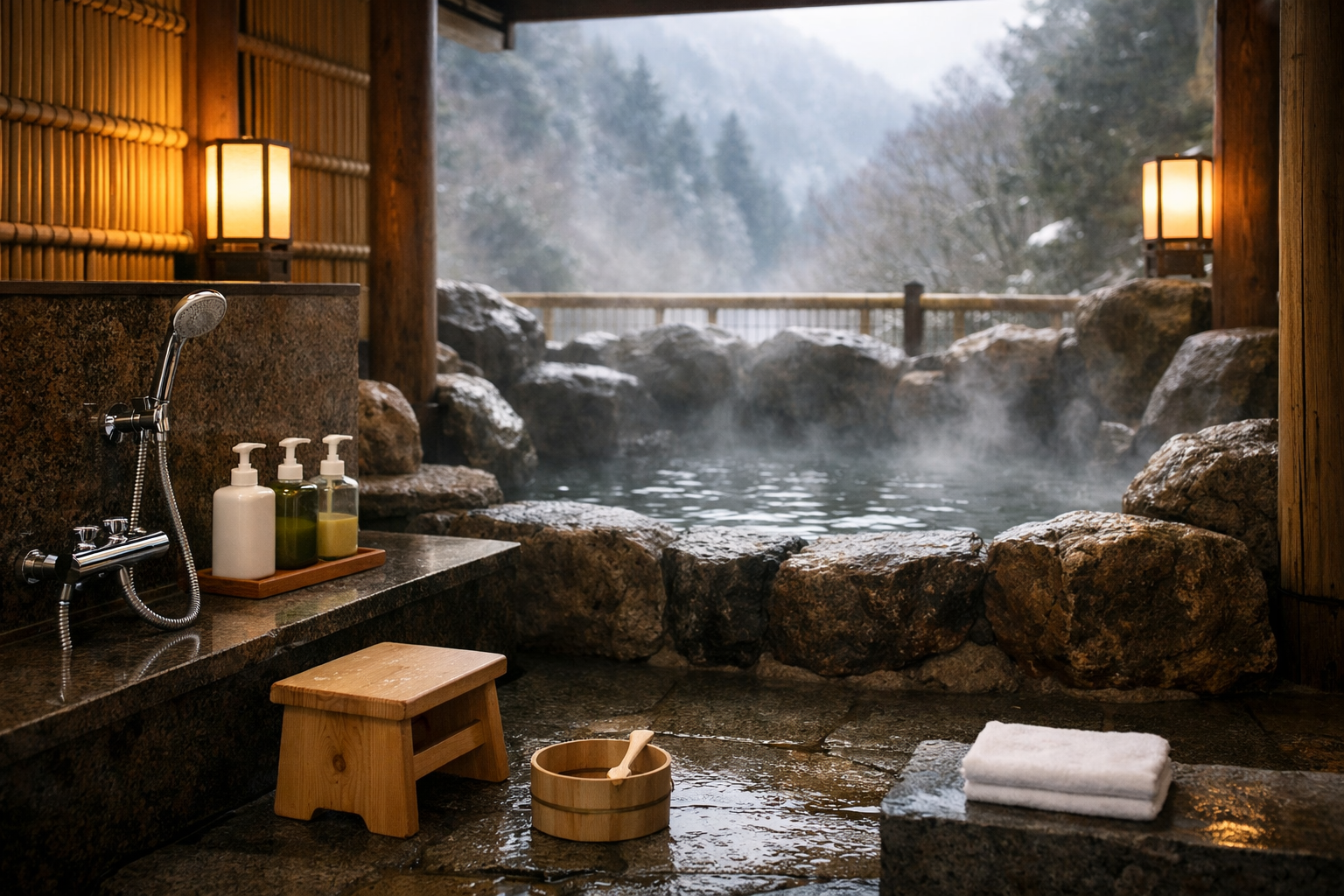
You arrive at the bathhouse, take off your shoes, and notice the sign: no swimsuits. Inside, there are rows of low stools, shower heads, buckets, and a steaming communal bath. The question most first-time visitors have is immediate: Do I wash first, or get in first?
The answer is simple: at most Japanese communal baths, you remove all clothing, wash your body thoroughly at the shower area, then enter the large bath to soak. Once you know that sequence, Japanese onsen etiquette becomes much less intimidating.
An onsen is not a spa where you rush through a treatment. It is shared bathing, with a clear boundary between the place where you clean yourself and the water everyone uses for soaking. Follow that distinction, respect privacy, and you will already be doing the important things right.
Japanese Onsen Etiquette at a Glance
- At most communal baths, bathing is nude: swimsuits and underwear are not worn.
- Remove outdoor shoes at the entrance and use the shoe locker or shelf provided.
- Check the men’s and women’s entrances every time; some facilities rotate them.
- Wash and rinse thoroughly before entering the soaking bath.
- Tie up long hair and keep it out of the water.
- Keep the small washing towel out of the bathwater.
- Do not bring phones, cameras, food, drinks, or large towels into the bathing area.
- Enter hot water slowly, speak quietly, and do not swim or splash.
- Dry yourself with the small towel before stepping back into the changing room.
- Check tattoo, child, private-bath, and accessibility policies before you arrive.
What Is an Onsen? And How Is It Different From a Sento?
In everyday travel language, an onsen is a bath using natural hot-spring water. Under Japan’s Hot Springs Act, however, water does not need to be visibly steaming from the ground to qualify: it may be recognized as a hot spring because of its temperature at the source or because it contains specified natural substances. For visitors, the practical point is that a true onsen uses qualifying natural spring water, often with a distinctive mineral composition.
A sento (銭湯) is a public bathhouse. Traditionally, a sento heats ordinary water, although some sento also use hot-spring water. The bathing routine is almost identical: undress, wash at a station, and soak in the communal bath.
A super sento is a larger modern bath and wellness complex, often found in cities and suburbs. It may have several indoor and outdoor baths, saunas, relaxation rooms, restaurants, massage services, and sometimes a mixed-gender area where swimwear is required. Do not assume that every part of a super sento follows the same clothing rules.
Choose the Right Type of Bath for Your First Visit
The word “onsen” covers several experiences. Knowing which one you are booking or walking into can prevent awkward surprises.
Ryokan communal bath
A ryokan is a traditional inn, and its bath is usually included for overnight guests. You normally wear a yukata from your room to the bath area, then bathe nude in a gender-separated communal bath. Amenities such as shampoo and body wash are often provided, but confirm what your accommodation offers. Some ryokan switch the men’s and women’s sides at certain times, so read the curtain and signs each visit.
Standalone day-use onsen
A day-use facility sells admission to bathers who are not staying overnight. You may pay at a front desk, ticket machine, or reception counter, then use shoe lockers and changing-room lockers. Towels may be rented or sold separately, and admission hours can be different from the building’s opening hours. Check the last-entry time, not just the closing time.
Neighborhood sento
A local sento is often the most ordinary, affordable version of communal bathing. It may be compact, have fewer English signs, and require you to bring or rent toiletries. Some use baskets rather than full-size lockers for clothing, so use a secure locker for valuables when one is available.
Super sento and spa complexes
These larger facilities can be approachable for first-time visitors because they often have clear signage, multiple bath temperatures, and more amenities. Still, they can be busier, louder, and more complicated than a small onsen. The nude bathing area is usually separated by gender, while any pool-like or mixed-use zone may have its own swimwear policy.
Private baths and family baths
A reservable private bath is commonly called a kashikiri-buro (貸切風呂). A kazoku-buro (家族風呂), or family bath, is a related term often used for private bathing spaces intended for a family or small group. These may be booked in advance, reserved at reception for a fixed time, or included with certain room plans.
Private baths are useful for couples, families, people who need assistance, and travelers who prefer privacy. They may cost extra, have limited availability, and do not automatically mean tattoos are permitted; confirm the property’s policy before booking.
If an overnight onsen stay suits your trip, you can compare ryokan and other accommodation options in Japan. Check each property’s room and bathing details carefully, especially if you need a reservable private bath.
Swimwear spa zones
A few resorts, water facilities, and mixed-gender spa areas require swimwear. These are different from the standard communal bath. If you want to wear a swimsuit, look specifically for a facility that states this clearly rather than arriving at a traditional onsen expecting an exception.
What to Check Before You Go
A few minutes of planning can make an onsen visit much smoother. Check the facility’s official website, booking page, or reception information for the following:
- Opening hours and last admission time
- Scheduled cleaning closures or maintenance days
- Whether towels, shampoo, body wash, and hair dryers are included, rented, or sold separately
- Whether lockers require coins, a deposit, or a wrist key
- Tattoo policy and whether cover seals are accepted
- Private-bath availability, reservation requirements, and extra charges
- Rules for babies in diapers, toilet-trained children, and opposite-sex bathing with a parent
- Accessibility features, including steps, handrails, shower chairs, and barrier-free private baths
- Whether the men’s and women’s bath areas rotate during the day
For popular ryokan and private baths, ask before arrival rather than assuming you can reserve a time on the day. This matters especially on weekends, holidays, and in well-known hot-spring towns.
How to Use an Onsen Step by Step
1. Pay admission and remove your shoes
At a day-use facility, payment may happen at reception or through a ticket machine. Keep your admission ticket, locker key, or wristband with you if instructed. At the entrance, remove outdoor shoes and place them in the designated shoe locker or shelf.
This shoe boundary is more than a formality. It marks the transition from outdoors to the clean interior of the bathhouse.
2. Find the correct bath entrance
Most communal baths are divided into men’s and women’s sections. Look for the Japanese characters rather than relying only on curtain color:
- 男湯 (otoko-yu): men’s bath
- 女湯 (onna-yu): women’s bath
Blue often indicates men and red often indicates women, but this is not universal. At ryokan and larger bathhouses, the entrances may switch after cleaning or at different times of day. Check the current sign every visit.
3. Undress in the changing room
At most nude communal baths, all clothing comes off, including underwear. Put your clothes, large bath towel, phone, wallet, and other belongings in a locker or basket. If the facility provides a small key on an elastic wristband, wear it on your wrist while bathing.
Bring only the small washing towel and any permitted toiletries into the bathing area. The small towel can provide a little coverage while walking, but it is not meant to be worn in the water.
4. Wash at a shower station before soaking
The large bath is for soaking, not for washing. Before entering it, choose an open washing station. You will usually find a low stool, bucket, mirror, handheld shower, and dispensers for soap and shampoo.
Sit on the stool, rinse your body, wash thoroughly, and rinse away all soap and shampoo. Remove sweat, makeup, sunscreen, and any product that could end up in the shared water. If you wash your hair, make sure it is fully rinsed and tie it up afterward if it is long enough to touch the water.
Keep splashing to a minimum. The low stools make it easier to wash without spraying neighboring bathers. When you finish, rinse the stool and bucket for the next person if the facility’s setup suggests this practice.
5. Acclimatize with warm water
Before entering a hot bath, many people use kakeyu (かけ湯): pouring warm water over the legs, arms, and torso to get used to the temperature. A shower or bucket may be used depending on the facility.
There is no need to perform a dramatic ritual. The point is practical: enter slowly, especially if the water is hot. Do not sit on the bath rim for an extended time; use the designated washing area or edge only as needed to enter safely.
6. Soak quietly and keep the water clean
Ease into the bath rather than jumping in. Keep your hair, towel, soap, and shampoo out of the water. A small towel is often folded and placed on the head; some facilities provide a shelf or designated dry area. Avoid leaving it on the bath rim unless the facility clearly allows that.
Quiet conversation is usually fine, particularly among friends or family, but communal baths are not swimming pools. Do not swim, splash, dive, or play loud music. Phones and cameras should remain in your locker: photography in changing rooms and bathing areas is generally prohibited for privacy reasons.
If the water feels uncomfortably hot, take a short break outside the bath, cool down, and try a different pool if one is available. Many facilities have baths at different temperatures, outdoor baths, saunas, or cold-water tubs. Use them at your own comfort level.
7. Leave carefully and dry before the changing room
When you are ready to leave, use the small towel to wipe away as much water as possible before crossing back into the changing room. This small courtesy keeps the floor safer and drier for everyone.
Whether to rinse after soaking depends on the facility and the type of water. Some bathers leave the mineral water on their skin, while others prefer a final rinse. Follow posted instructions, and rinse if the water feels irritating or if you have sensitive skin. Dry fully with your large towel at your locker, rehydrate, and give yourself time to cool down before heading outside.
What to Bring—and What to Leave in the Locker
Many larger facilities provide nearly everything, but smaller sento and day-use baths may not. A practical onsen kit includes:
- A small washing towel and a large drying towel, if towels are not included
- A hair tie for long hair
- Shampoo, conditioner, and body wash if the facility does not provide them
- Coins, a payment card, or another accepted payment method
- A reusable water bottle for before and after bathing, where outside drinks are permitted
- An approved tattoo cover seal only if the facility has confirmed that covers are allowed
Leave phones, cameras, food, and large towels in the locker. Avoid taking glass containers into wet areas. Jewelry is also best removed: mineral-rich water may affect some metals, and rings can be uncomfortable when your body warms up.
Do not drink hot-spring water unless there is a clearly designated drinking source and the facility specifically states that it is safe to consume.
Onsen Tattoo Rules: A Practical Way to Check
Tattoo policies vary more than many travelers expect. Some facilities welcome tattooed guests, some permit small tattoos only when covered, and some do not allow tattoos in communal bathing areas. Policies can also change, so do not rely entirely on an old blog post or review.
Before visiting, use this process:
- Check the facility’s official website and booking information.
- Search the site for “tattoo,” or the Japanese terms タトゥー and 入れ墨 (irezumi).
- Ask directly if the wording is unclear. Hotel or ryokan staff can often contact the bathhouse for you.
- Ask specifically whether tattoo-cover seals are accepted. A cover patch is not a universal workaround.
- If communal bathing is not permitted, ask about a reservable private bath, but confirm that the property permits tattooed guests there as well.
A useful question is: タトゥーは大丈夫ですか? (Tatū wa daijōbu desu ka?) — “Are tattoos allowed?” For a private bath, ask: 貸切風呂を予約できますか? (Kashikiri-buro o yoyaku dekimasu ka?) — “Can I reserve a private bath?”
If a facility declines entry, do not argue with staff. Choose another bathhouse or a private option. The most comfortable experience is one where the policy is clear before you undress.
Families With Children
Children can use many onsen, but policies are highly facility-specific. Some baths do not allow diapers in the water, even swim diapers. Others require children to be toilet trained, while some have different rules for infants and young children. Check before going rather than assuming a family-friendly hotel has the same policy as its bathhouse.
Rules about the age at which a child may enter the opposite-sex bath with a parent also vary by prefecture, municipality, and facility. Ask the front desk if you are unsure.
A private or family bath can be the easiest choice for parents with young children. It gives you space to manage bathing, noise, and changing without worrying about a crowded communal room. In any setting, supervise children closely: wet floors, steps, deep water, and hot baths require attention.
Couples, Privacy, and Travelers Uncomfortable With Nudity
Most standard communal baths are gender-separated, so couples generally cannot soak together there. A reservable private bath, an open-air bath attached to a guest room, or a facility with an explicitly designated mixed-gender swimwear area is the practical alternative.
If public nudity feels too stressful, there is no need to force the experience. Private baths offer the same basic sequence—wash first, then soak—with far more privacy. Note that a room bath is not necessarily supplied by genuine hot-spring water, so ask if that matters to you.
Travelers who are transgender or nonbinary may encounter facilities that assign communal-bath access by the gender shown in their rules or documentation. Policies are not consistent nationwide. A private bath is often the least stressful option, and contacting the property before booking is the best way to understand its current approach. The same advance confirmation is wise for anyone who needs a caregiver or companion in the bathing area.
Accessibility and Mobility Considerations
Traditional bathhouses can be challenging for travelers with mobility needs. Floors are wet and slippery, entrances may have steps, washing stations use low stools, and outdoor baths can involve uneven stone paths. Even a modern-looking facility may not be fully barrier-free.
Before visiting, contact the property directly and ask about:
- Step-free access from the entrance to the bath
- Handrails, shower chairs, and accessible changing rooms
- Depth and entry method for each bath
- Wheelchair storage and transfer arrangements
- Whether a companion or caregiver may assist
- Barrier-free private baths, which may be more manageable than a communal area
Heat can also be tiring. Choose a facility with several bath temperatures, take breaks, and do not feel pressured to use every pool.
Health and Comfort: When to Take Extra Care
Hot baths can make people lightheaded, particularly after travel, exercise, alcohol, or a long day outdoors. Do not enter if you are intoxicated, severely dehydrated, feverish, acutely unwell, or already dizzy. Leave the water immediately if you feel faint, weak, nauseated, overheated, or uncomfortable.
Follow the facility’s posted warnings, especially around very hot baths, saunas, cold plunges, and strong mineral waters. If you are pregnant, have a medical condition, have open wounds, are recovering from an injury, or have concerns about heat exposure or skin sensitivity, seek advice from an appropriate medical professional before bathing.
There is no prize for staying in longer. Short, comfortable soaks with rest and water in between are a sensible approach.
Choosing an Onsen Experience in Japan
Different hot-spring regions suit different travel styles. These examples are useful not because one is “best,” but because each makes the onsen experience feel different.
- Hakone: A convenient choice from Tokyo, with many ryokan stays, day-use baths, and views of mountains and lakes. It is practical for travelers who want to try an onsen without building an entire trip around one town.
- Kusatsu Onsen: Known for a strong hot-spring identity and famously hot water. It is a good reminder to enter gradually and take breaks rather than treating every bath as a challenge.
- Kinosaki Onsen: A compact town associated with strolling between public bathhouses in yukata. It is especially appealing for travelers who want the bathhouse routine to be part of an overnight ryokan stay.
- Beppu: A broad hot-spring area with varied bathing styles and landscapes. It suits curious visitors who want to see how many forms geothermal culture can take.
- Kurokawa Onsen: A rural hot-spring village valued for its atmospheric outdoor baths and slower pace. It is a strong choice for travelers seeking a traditional mountain setting.
- Noboribetsu: One of Hokkaido’s best-known onsen areas, with varied mineral waters and a dramatic volcanic landscape. It is particularly compelling in cooler weather.
Regardless of destination, individual properties set their own rules. A famous onsen town does not guarantee that every bathhouse has the same tattoo policy, child policy, or accessibility level.
When comparing places to stay, look beyond the word “onsen” and confirm whether the property offers communal baths, private baths, in-room open-air baths, or day-use access. You can browse Japan accommodation and travel options for the destinations that fit your itinerary.
Useful Japanese Words at an Onsen
- 温泉 (onsen): hot spring
- 銭湯 (sentō): public bathhouse
- 露天風呂 (rotenburo): outdoor bath
- 貸切風呂 (kashikiri-buro): reservable private bath
- 家族風呂 (kazoku-buro): family bath or private bath for a small group
- タオルはありますか? (Taoru wa arimasu ka?): “Are towels available?”
- 男湯はどちらですか? (Otoko-yu wa dochira desu ka?): “Which way is the men’s bath?”
- 女湯はどちらですか? (Onna-yu wa dochira desu ka?): “Which way is the women’s bath?”
Frequently Asked Questions About Japanese Onsen Etiquette
Do you have to be naked in an onsen?
At most traditional communal onsen and sento, yes. Clothing and swimwear are normally removed before entering the bathing area. Private baths and designated swimwear spa zones are the main exceptions.
Can you wear a swimsuit in an onsen?
Not in most standard communal baths. If you prefer swimwear, find a facility that explicitly advertises a swimwear-required or swimwear-permitted area.
Can you cover yourself with a towel?
You may carry the small washing towel for limited coverage while walking, but it does not go into the bathwater. Once soaking, place it on your head or in a permitted dry area.
Do you wash before or after soaking?
For a first visit, wash and rinse thoroughly before entering the shared bath. After soaking, follow the facility’s instructions. A final rinse is a personal choice at many baths, but may be sensible if the water irritates your skin.
Can people with tattoos use an onsen?
Sometimes. Policies range from fully permitted to prohibited, with many variations in between. Check the official policy, ask directly about cover seals, and consider a private bath if needed.
Can couples bathe together?
Usually not in gender-separated communal baths. Couples can often bathe together in a reservable private bath or an approved mixed-gender swimwear area.
Can children use an onsen?
Often yes, but rules for diapers, toilet training, supervision, and opposite-sex bathing vary. Confirm directly with the facility, especially when traveling with babies or young children.
Can you take a phone into the changing room or bath?
Assume no. Phones and cameras create privacy concerns and are generally prohibited in communal changing and bathing areas. Store them in your locker.
How long should you soak?
There is no universal time limit. Leave whenever you feel too warm or uncomfortable, rest between baths, and hydrate. Short soaks are perfectly normal.
Plan Your Japan Trip
If you are planning an onsen visit, compare accommodation locations, room types, and transport options before booking. Always confirm bath policies directly with the property.
The essential rule behind Japanese onsen etiquette is straightforward: clean yourself before entering water that other people will share. Add quiet behavior, privacy awareness, and a quick check of the facility’s own rules, and the unfamiliar parts of the experience quickly become manageable.
コメントを残す