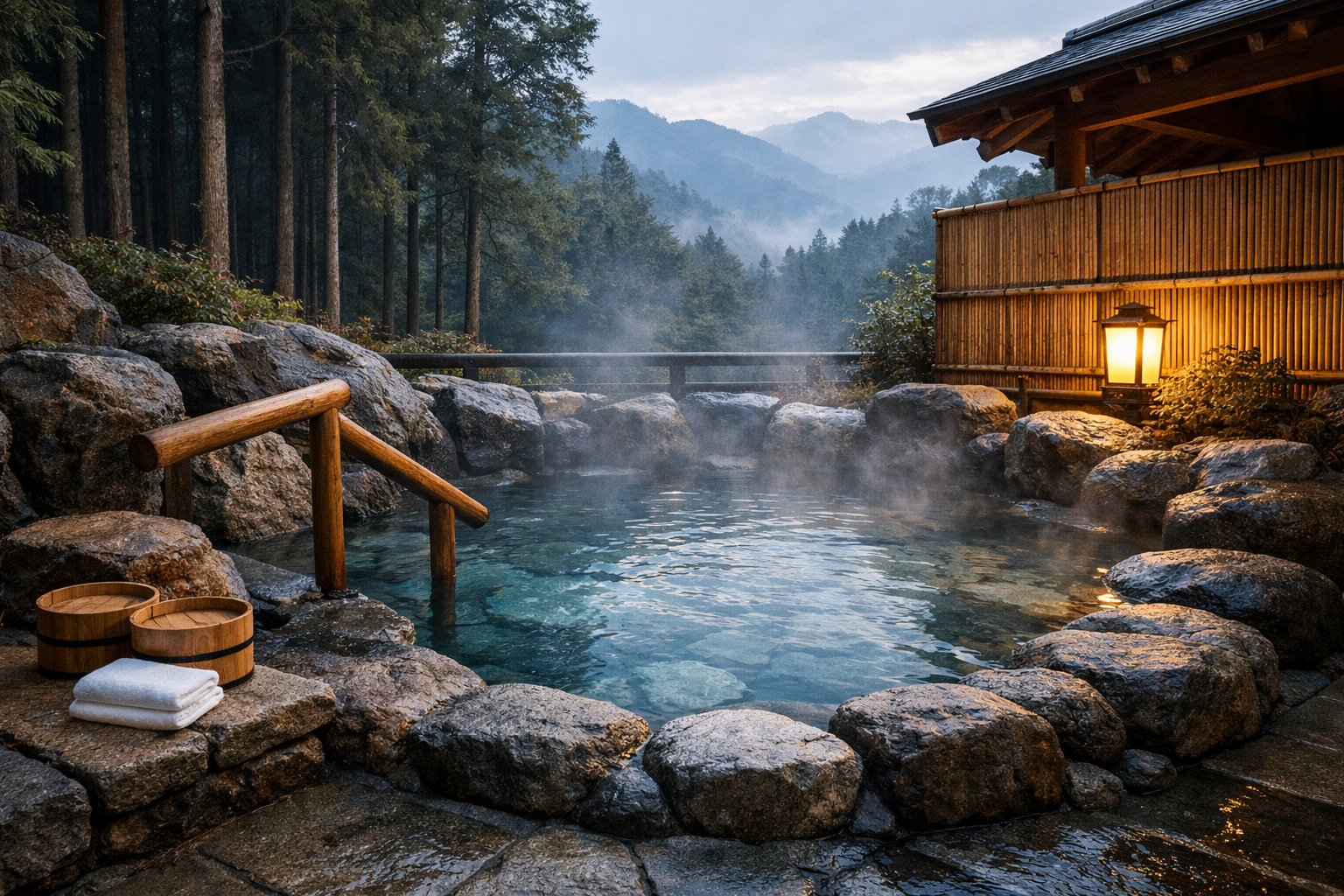
The first surprise at a Japanese onsen is obvious: in most gender-separated communal baths, everyone is nude. The second is the rule that catches more first-time visitors off guard: you wash yourself thoroughly before entering the shared water.
That simple sequence explains most Japanese onsen etiquette. The bath is a place to soak, not to scrub. The tiny towel is useful, but it must stay out of the water. Privacy is taken seriously, so phones stay in the locker. Once you understand the rhythm, the experience is far less complicated than it first appears.
Individual facility rules always override general guidance, especially for tattoos, children, swimwear, private baths, and accessibility. Check the exact bath you plan to visit before you go.
Onsen Etiquette in 30 Seconds
- Check the facility’s tattoo, child-access, and towel policies before arriving.
- Store shoes where the facility indicates, then use the correct changing room.
- Undress completely in a standard gender-separated communal bath; swimsuits are usually not allowed unless expressly permitted.
- Leave your large drying towel in the changing room and take only the small towel into the bathing area.
- Wash and rinse your body completely at a shower station before soaking.
- Keep both long hair and the small towel completely out of the bath water.
- Enter slowly, soak quietly, and leave if you feel overheated or unwell.
- Wipe off before returning to the changing room, then hydrate and cool down.
Onsen vs Sento, Super Sento, Hotel Spa, and Private Bath
These terms can describe the water, the business, or the style of bathing. They overlap more than many travel guides suggest.
| Term | What it usually means | What it does not guarantee |
|---|---|---|
| Onsen (温泉) | A bath using water that qualifies as hot-spring water under Japan’s Hot Springs Act. Qualifying underground water may meet the standard through its temperature or through specified mineral, gas, or other components. | That the facility is traditional, tattoo-friendly, private, or swimsuit-friendly. |
| Sento (銭湯) | A public bathhouse. It may use ordinary heated water or onsen water. | That it is not an onsen. Some sento are also onsen. |
| Super sento | A larger, leisure-oriented bath complex, often with several baths, saunas, restaurants, and relaxation areas. | That every pool uses natural hot-spring water. |
| Hotel spa or public bath | A bathing facility at a hotel, resort, or wellness property. | That its water qualifies as onsen water, or that outside guests may use it. |
| Private bath | A bath reserved for exclusive use by one person, family, or group. | Onsen water, step-free access, tattoo permission, swimwear permission, or eligibility for all couples. |
On booking pages, you may also see rotenburo (露天風呂), an outdoor bath; kashikiri-buro (貸切風呂), a reservable private bath; kazokuburo (家族風呂), a family bath; and konyoku (混浴), mixed-gender bathing. Mixed bathing has no single dress code: some traditional facilities are nude, while some modern areas require approved bathing wear. Never assume.
How to Use a Japanese Onsen: 15 Rules in Order
1. Check the facility policy before leaving your hotel
A quick check can prevent an awkward arrival. Look for the official policy on tattoos, children, diapers, mixed bathing, bathing garments, private-bath reservations, and day-use admission. If the website is unclear, contact the facility directly or ask your accommodation to call.
Posted rules can change, and they may differ between a property’s public bath, private bath, pool area, and in-room tub.
2. Do not bathe after heavy drinking, and arrive hydrated
Hot water can make dehydration, dizziness, and fatigue worse. Avoid entering while intoxicated, and drink water before bathing. Take extra care if you have a fever, feel ill, have open wounds, or are already overheated after exercise or sightseeing.
People who are pregnant, have cardiovascular conditions, take medication that affects heat tolerance or blood pressure, or have other health concerns should seek appropriate medical advice and follow the facility’s posted guidance. This is not the moment to prove that you can tolerate the hottest pool.
3. Bring the right things—but do not assume towels are included
Many facilities rent or sell towels, soap, shampoo, and other basics, but others expect guests to bring them. A small local sento may be more minimal than a ryokan or large bath complex.
- A small wash towel and a large drying towel, if required
- A hair tie or clip for long hair
- Coins, a payment card, or cash for lockers, entry, and rentals
- A small bag for damp items after bathing
- Your own toiletries if you prefer them
Do not bring valuables, cameras, or a phone into the bathing area. If the facility supplies a locker key on a wristband, follow its instructions carefully; layouts and locker systems vary.
4. Remove your shoes where the facility indicates
Outdoor shoes do not belong in the changing or bathing areas. At some facilities, shoe lockers are before reception; at others, you pay first and remove shoes afterward. Follow signs and the layout rather than assuming one universal sequence.
You may pay at a desk, buy a ticket from a vending machine, or scan into a modern facility. If you are unsure, show the staff your ticket or ask, “Onsen wa doko desu ka?” (“Where is the bath?”).
5. Confirm the correct changing room
The usual signs are:
- 男 = men
- 女 = women
Blue is often associated with men and red with women, but color is not reliable enough on its own. Some inns rotate baths by time of day, so the entrance that was for men in the afternoon may be for women at night. Read the characters and posted schedule, or ask the front desk.
6. In a standard communal bath, undress in the changing room
Gender-separated Japanese bath areas are normally nude. Swimsuits, underwear, and wrapped towels are generally not permitted unless the facility explicitly says otherwise. The small towel may be held discreetly while walking between the changing room, washing area, and bath, but it is not clothing.
The atmosphere is usually practical rather than performative. People tend to focus on washing and relaxing, not on examining strangers. Keep your movements calm, use your locker, and follow the sequence.
7. Leave the large towel behind and protect everyone’s privacy
Keep your large drying towel in the changing room or locker. Take the smaller towel into the bathing area for washing and for lightly drying your feet before you return.
Phones, cameras, smartwatches with cameras, and other recording-capable devices should remain outside changing and bathing areas. Even a scenic outdoor bath is not a photo opportunity when other people may be undressed nearby. Only take photographs where the facility has clearly created and authorized a controlled photo area.
8. Wash at a shower station before entering the shared bath
This is the central rule of Japanese bath etiquette. Sit on the low stool at an open washing station, rinse your body, wash with soap, and rinse off all foam before soaking. Standing to shower may splash nearby bathers, particularly in a busy room, so sitting is the normal approach.
Use only your own station and keep bottles, towels, and baskets tidy. Some facilities provide soap and shampoo; others do not. If shaving is permitted, it belongs at the washing station, never in the soaking pool. When in doubt, follow the posted rules.
9. Rinse the stool and bucket when you are finished
If you used a plastic stool or bucket, rinse it and return it neatly. This small detail makes sense in a shared space where the next person will use the same equipment. Avoid leaving hair, foam, or personal toiletries behind.
10. Use kakeyu before getting in, especially if the water is hot
Kakeyu means pouring water over your body before entering the bath. It helps you adjust to the temperature and removes any remaining sweat or residue. Use a bucket or your hands to wet your legs, arms, and torso gradually.
Kakeyu is not a substitute for a proper wash when you have arrived from outside and the facility expects you to clean first. If you use a sauna, rinse off sweat before returning to the bath.
11. Tie up long hair and keep the small towel out of the water
Hair should not trail in the communal water. Tie long hair up securely, or otherwise keep it above the waterline.
The small towel must also stay completely out of the bath. Many bathers fold it and place it on their head. A clearly dry, designated place nearby can also work if available. Do not leave it where it blocks a path, and do not rest it in a puddle at the bath edge and then return it to the water area.
12. Enter slowly, soak briefly at first, and do not swim
Lower yourself into the bath carefully rather than jumping, splashing, or rushing in. The water may be much hotter than expected. For a first soak, keep it short, step out to cool down, and return only if you feel comfortable.
Leave the bath immediately if you feel dizzy, nauseated, faint, unusually short of breath, or unwell. Wet floors can be slippery, so walk rather than run. Children need especially close supervision around hot water and slick surfaces.
13. Keep the shared atmosphere comfortable
Quiet conversation is often fine, but an onsen is not a swimming pool or a party venue. Keep voices low, avoid horseplay, and give other bathers space. Do not wash clothing, rinse your towel, brush your teeth, or use soap in the soaking water.
Some pools have their own instructions: a cold bath, sauna, medicinal-style bath, or outdoor bath may have capacity limits or specific entry rules. Read the signs before using them.
14. Wipe off before returning to the changing room
When you finish, use the small towel to remove as much water as you can before stepping back into the changing area. You do not need to dry completely until you reach your large towel, but you should not drip across the floor or sit wet on benches.
Dry fully at your locker, gather your belongings, and make sure you have not left toiletries or clothing behind.
15. Cool down and rehydrate before continuing your day
Give your body a little time after bathing. Drink water, rest in the lounge if there is one, and avoid rushing straight into strenuous activity. A cold drink after a bath is a familiar pleasure in Japan, but water is the sensible first choice.
If you are staying at a ryokan, bath hours may be limited and some baths may switch between men’s and women’s use. Your room may include a basket, towel set, and yukata robe for the walk to the bath. Bring only what the property tells you to bring, and secure your room key according to its instructions.
Onsen Tattoo Rules: How to Get a Clear Answer
Tattoo policies are primarily facility-specific. A small neighborhood sento may welcome tattooed guests, while a resort bath or hotel spa may prohibit visible tattoos. Another facility may allow only tattoos covered by approved patches. There is no dependable nationwide rule—and policies can change.
Use this sequence before making the trip:
- Read the exact facility’s official tattoo policy, preferably in Japanese as well as English if both are available.
- Find out whether all tattoos are accepted, only fully covered tattoos are accepted, or tattoos are not permitted.
- If covers are allowed, confirm the permitted patch size and number. Do not assume your own bandage or clothing is acceptable.
- Ask whether a private bath is available and whether its tattoo policy is different from the public bath policy.
- Get confirmation in writing when possible, especially if you are booking a stay or traveling a long distance.
A private bath can offer more privacy, but it does not automatically override a property’s tattoo rules. It may also have its own reservation fee, time limit, cleaning interval, and guest eligibility requirements.
Private Onsen in Japan: What “Private” Really Means
A kashikiri-buro is a bath reserved for exclusive use during a set time slot. A kazokuburo is often intended for families or small groups. They can be a practical choice for couples, families, nervous first-timers, guests requiring assistance, and travelers seeking more privacy.
Still, confirm the details. A private bath may be available only to overnight guests, may require an advance reservation, or may not use qualifying onsen water. An in-room tub is not automatically an onsen bath either. Private does not mean that hygiene rules disappear: wash first, keep towels out of the water unless the property says otherwise, and follow the same heat-safety precautions.
When comparing ryokan or resort stays, look beyond the phrase “private onsen.” Check whether the bath is reservable, whether it is indoors or outdoors, whether there are steps, how long each slot lasts, whether day-use is possible, and what the official tattoo policy says.
You can compare ryokan and hotel options in Japan, then confirm bath access, private-onset reservations, and tattoo policies directly with the property before booking.
Children and Families at an Onsen
Families are welcome at many Japanese bath facilities, but rules for children vary. Some properties restrict diapered children, require swim diapers in designated family areas, limit access to certain pools, or set their own supervision requirements. Always check in advance.
Opposite-sex child bathing is another area where travelers should not rely on a single age found online. Limits can depend on prefectural, municipal, and facility rules, and they may change. Contact the facility directly if this affects your family.
- Take children to the toilet before entering the bath.
- Wash them before they soak, just as adults do.
- Keep them close: water can be hot, floors are slippery, and bath depths vary.
- Keep voices and play calm; communal baths are not designed for splashing games.
- Consider a reservable family bath if your children are young, anxious, or likely to need more space.
Guidance for Transgender and Nonbinary Travelers
Most communal baths are organized into male and female changing and bathing areas. Facilities may not have a uniform approach for transgender or nonbinary guests, and staff discretion, local culture, and the layout of the bath can all affect the practical experience.
If you have concerns, contact the facility privately before visiting and ask what option it recommends. A reservable private bath may be more comfortable for some travelers, but availability and admission policies still need to be confirmed. A respectful, direct inquiry before arrival is usually easier than trying to resolve a sensitive issue at a busy reception desk.
Accessibility and Bathing With Assistance
An onsen can involve shoe lockers, changing rooms, low washing stools, uneven stone surfaces, stairs, hot water, and slippery floors. A bath described as “private” is not necessarily step-free or accessible.
If you have limited mobility, use a wheelchair, need a carer, or require a bathing aid, contact the facility in advance and ask specific questions:
- Are there step-free entrances, handrails, transfer space, or accessible changing rooms?
- Are bathing wheelchairs or shower chairs available?
- How many steps lead into the bath, and is there a shallow entry?
- Can a carer enter or assist, and under what conditions?
- Is a private bath available that genuinely suits your access needs?
Staff cannot safely improvise every arrangement at the door, so advance communication matters.
Useful Japanese Onsen Signs and Words
- 温泉 (onsen) — hot spring
- 銭湯 (sento) — public bathhouse
- 露天風呂 (rotenburo) — outdoor bath
- 貸切風呂 (kashikiri-buro) — reservable private bath
- 家族風呂 (kazokuburo) — family bath
- 混浴 (konyoku) — mixed-gender bath
- 男 — men
- 女 — women
- 入れ墨・タトゥー — tattoos
- 湯あみ着 (yuami-gi) — bathing garment, when a facility permits or requires one
Japanese Onsen Etiquette FAQ
Can you wear a swimsuit in an onsen?
Usually not in a standard gender-separated communal bath. Swimsuits may be permitted in certain mixed-gender zones, pools, water parks, or facilities that specifically provide bathing garments. Follow the exact house rule.
Are tattoos allowed in Japanese onsens?
Sometimes, but not everywhere. Acceptance is decided by each facility. Check the official policy in advance, including whether tattoo covers are accepted and whether private baths follow different rules.
Do you have to wash your hair before entering an onsen?
You should wash your body and rinse off completely before soaking. Washing your hair is commonly done at the shower station too, especially if it is sweaty or has styling product in it, but the key requirement is to keep hair out of the bath water. Follow any facility-specific instructions.
Can couples bathe together?
Not in ordinary gender-separated communal baths. A mixed bath or reservable private bath may allow couples, but do not assume that every private bath accepts all guest combinations, permits swimwear, or is available to non-staying visitors.
Can children enter an onsen?
Many facilities allow children with an adult, but policies on diapers, supervision, bath temperature, and opposite-sex bathing vary. Check directly with the facility before visiting.
Final First-Time Onsen Checklist
- Check the exact facility’s tattoo, family, and access policies.
- Bring towels only if they are not provided or rentable.
- Use the correct changing room, especially at a bath with rotating entrances.
- Undress, wash thoroughly, and rinse all soap away.
- Keep hair and the small towel out of the water.
- Enter slowly, keep the atmosphere calm, and leave devices in the locker.
- Do not bathe while intoxicated or when unwell.
- Wipe off before the changing room, then drink water and cool down.
Plan Your Japan Trip
If an onsen or ryokan stay is part of your itinerary, compare properties carefully and confirm the bathing arrangements before booking:
The details may initially feel precise, but they serve a clear purpose: everyone enters the shared water clean, everyone’s privacy is protected, and the bath remains pleasant for the next person. Follow the posted rules, take your first soak slowly, and Japanese onsen etiquette will quickly become second nature.
コメントを残す