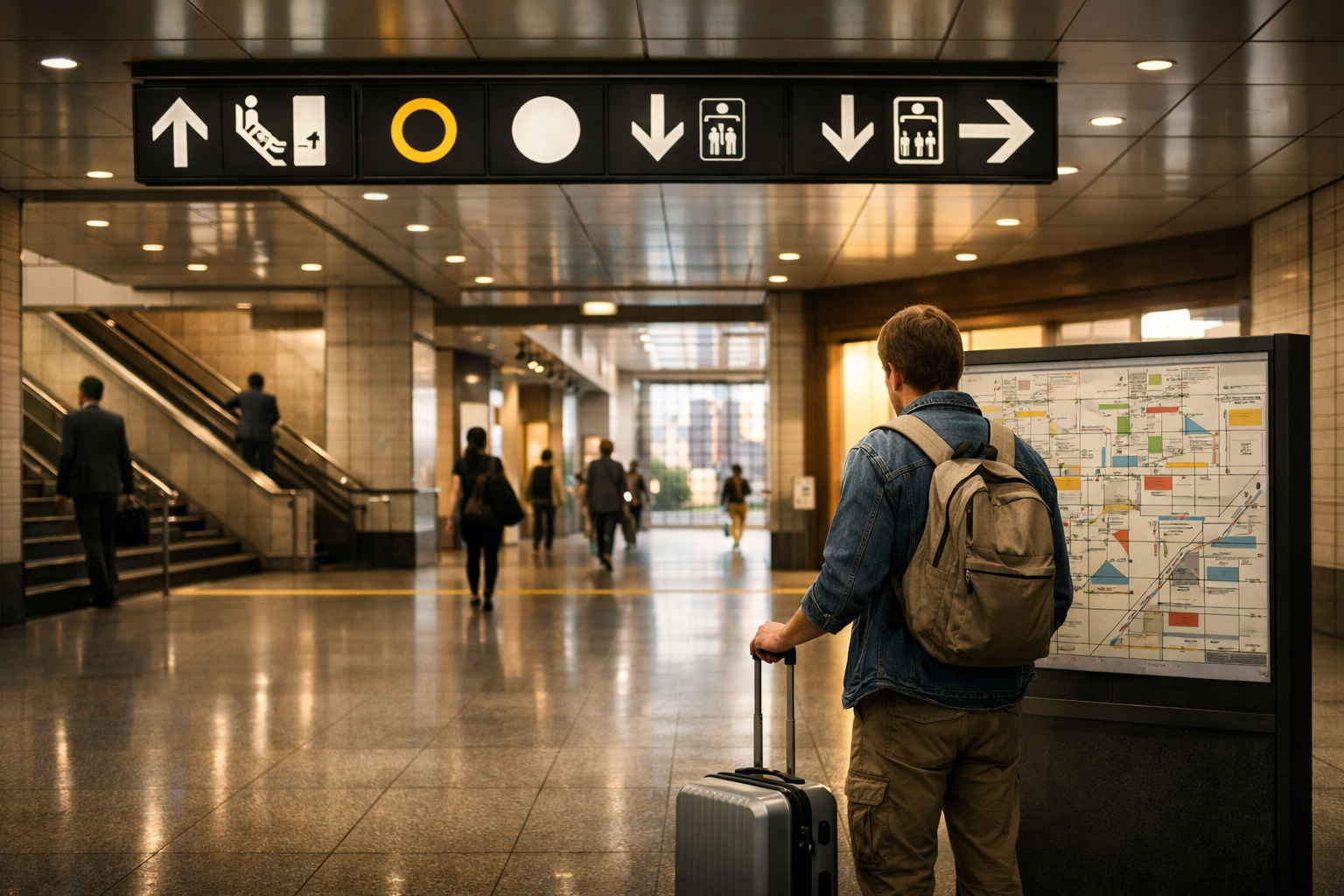
You can arrive at the correct station in Japan, follow the signs perfectly, tap through the ticket gate—and still emerge 15 minutes away from where you meant to be.
The reason is simple: many Japanese railway stations are not single buildings with one front door. They are sprawling networks of platforms, underground passages, department stores, shopping arcades, bus terminals, and several separately named exits. At major stations, choosing the right exit can matter almost as much as choosing the right train.
For first-time visitors, Japanese station exits can seem unnecessarily complicated. In practice, the system is usually logical once you know what the labels mean and how to use them. This guide explains how to choose the right station exit in Japan, what “East Exit,” “A4,” and “Central Gate” actually tell you, and what to do when you come out in completely the wrong place.
Why Japanese stations have so many exits
Japanese cities are dense, and rail stations are often built into the surrounding neighborhood rather than placed beside it. A large station may connect directly to offices, department stores, underground shopping streets, hotels, bus stops, taxi ranks, and multiple railway lines.
Instead of forcing everyone through one crowded entrance, stations distribute passengers through several exits. Each exit serves a different side of the neighborhood or a different transport connection.
At a smaller suburban station, the choice may be easy: East Exit or West Exit. At a major interchange such as Shinjuku, Tokyo, Umeda, Yokohama, Nagoya, or Hakata, you may encounter:
- East, west, north, south, central, or south-central exits
- Numbered underground exits such as A1, A4, B6, or C2
- Exits attached to a particular railway company or line
- Named gates leading to a landmark, department store, bus terminal, or shopping district
- Separate exits for different levels of the same station complex
This is not simply a matter of station size. Some areas have grown around rail hubs for decades, with new lines, passageways, and commercial buildings added over time. What looks like one station on a map may function more like a small indoor district.
The first rule: check the exit before you get off the train
The most useful habit is to look up your destination’s recommended exit before you arrive.
On Google Maps and many Japanese map listings, businesses and attractions often include directions such as “3 minutes from Shibuya Station, Exit B1” or “near Ueno Station’s Park Exit.” Hotel confirmations, restaurant reservations, museum websites, and event tickets may do the same.
If an address gives you an exit number or exit name, save it. That one detail can prevent a confusing walk around elevated tracks, multilane roads, or a huge station building.
Do not assume that the exit closest to your train platform is best. It may be faster to walk a few extra minutes inside the station than to exit first and walk around the entire complex outside.
What to search for
Before your journey, search for:
- [Destination name] nearest station exit
- [Destination name] access
- [Destination name] アクセス (access, in Japanese)
- [Station name] exit map
If you are visiting a small café, a clinic, a hotel, or a shop inside a busy commercial neighborhood, the business’s official website or social media account may have more precise access instructions than a general map.
How station exit labels work
Japanese stations use several labeling systems at once. Understanding the main types makes signs much less intimidating.
Directional exits: East, West, North, and South
Directional exits are common at above-ground stations. They refer broadly to the side of the station you will reach, not necessarily a perfectly precise compass direction.
If your hotel is on the east side of the tracks and you leave through the west exit, you may need to find a pedestrian bridge, underpass, or road crossing to get back to the other side. At a large station, that detour can be surprisingly long.
Directional exits are especially useful when meeting someone. “Meet at the East Exit” is a common arrangement, although at a very large station you may still need a more exact landmark, such as a specific gate, statue, or store.
Numbered exits: A1, A2, B3, and beyond
Numbered exits are most common in subway stations and underground station complexes. They usually lead to specific stairways or elevators at street level.
An exit labeled A4 may be only a minute from A3 underground, but above ground the two can open onto opposite corners of a major intersection. This matters if you are carrying luggage, trying to find an accessible route, or meeting a tour group on a busy street.
Letters often divide exits into areas or groups within the station. The exact system varies by operator and station, so do not try to interpret A or B as a universal code. Treat the full label—such as A6—as the important information.
Gates, ticket gates, and exits are not always the same thing
This distinction confuses many travelers.
A gate or ticket gate is where you leave the paid railway area after tapping your IC card or inserting your ticket. An exit may be farther beyond that gate, especially in a subway station or underground complex.
For example, you may see signs directing you to a “Central Gate,” pass through the fare gates, and then choose between exits A1 through A8. If your directions say “A4,” do not stop navigating once you reach the Central Gate.
Conversely, directions that say “use the Central Exit” may refer to a specific ticket-gate area rather than a numbered street exit. Read the wording carefully.
Named exits
Some exits are named after nearby destinations. You may see signs for a park exit, a bus terminal exit, a department store exit, or an exit associated with a landmark.
These can be especially helpful because they tell you what is nearby. If you are heading to a museum next to a park, the Park Exit is usually a better clue than trying to judge a compass direction from inside a station.
Still, follow your map as well as the station signs. Large complexes may have similarly named passageways, and a named exit can lead to more than one street-level entrance.
Follow signs by destination, not just by color or intuition
In a busy station, signs may point in several directions at once: trains, subway transfers, department stores, buses, taxis, lockers, and exits. It is easy to start following the crowd and end up heading toward a different railway line.
The safest approach is to look for the exact exit name or number. Japanese station signs generally include English for major navigation information, particularly in urban areas and tourist destinations. You may also see the exit label in Japanese:
- 出口 (deguchi) — exit
- 東口 (higashiguchi) — east exit
- 西口 (nishiguchi) — west exit
- 北口 (kitaguchi) — north exit
- 南口 (minamiguchi) — south exit
- 中央口 (chūōguchi) — central exit
If you cannot immediately see your exit, look for a large station map. These are often positioned near concourses, ticket gates, and escalator banks. The maps may look busy, but they can show which exits connect to nearby landmarks, streets, and bus stops.
Use your phone without walking into people
Navigation apps are extremely useful in Japan, but stations are not good places to walk while staring at a screen. Platforms, stairways, escalators, and narrow passages become crowded quickly, particularly during commuting hours.
A better routine is:
- Check the route while waiting for the train or after stepping aside from passenger flow.
- Note the exit name or number.
- Follow the overhead signs toward that exit.
- Check your map again once you are outside and have identified the street.
GPS can be unreliable underground or among tall buildings, so do not panic if your location marker jumps around inside a station. Station signage is often more reliable until you reach street level.
Why the “wrong” exit can be a real problem
Leaving from the wrong exit is rarely disastrous, but it can be inconvenient in ways that are not obvious from a map.
Railway tracks, expressways, rivers, construction barriers, elevated roads, and massive station buildings can divide neighborhoods into sections that are close as the crow flies but awkward on foot. The opposite side of a station may require a long detour.
This is particularly relevant if you are:
- Carrying a suitcase or pushing a stroller
- Trying to catch a reserved train, airport bus, or tour departure
- Meeting someone at a specific time
- Heading to a restaurant reservation
- Traveling in rain, summer heat, or winter weather
- Looking for a particular bus stop or taxi stand
On the other hand, choosing the wrong numbered subway exit may only add a few minutes. The practical response is simple: reorient yourself, check the map, and walk from where you are. Going back underground is not always necessary.
What to do if you exit in the wrong place
Everyone does it eventually, including experienced travelers and residents. The key is not to keep walking in the hope that things will become familiar.
Stop somewhere out of the way
Move away from the exit stairs and avoid blocking the flow of people. Then check your map and identify a visible reference point: a major road, convenience store, department store, intersection, or station entrance.
Look for the station name above ground
Large stations can have several entrances that look alike. If you decide to re-enter, confirm the station name and railway operator displayed near the entrance. In major cities, different companies’ stations may be connected but have separate gates and signage.
Do not assume every station entrance leads to every line
Some entrances are convenient for one subway line, shopping complex, or railway company but not another. If you need to return to a particular platform, follow signs for the line name rather than just entering the nearest doorway.
Ask for the landmark, not a long address
If you need help, a short question with a destination name is usually easier than showing a full address. You can say:
“Sumimasen, [place name] wa dochira desu ka?”
Excuse me, where is [place name]?
Showing the destination on your phone is perfectly acceptable. Station staff, shop employees, and passersby may not know every small business, but they can often point you toward a street, exit, or familiar landmark.
Transfers: the exit you want may be inside the station
A common mistake is leaving through a ticket gate when you actually need to transfer to another line. In Japan, many transfers happen entirely within the paid station area. Look for signs marked Transfer, JR Lines, the relevant subway line, or the destination station.
If your route planner says you need to change trains, do not head toward an exit unless the instructions specifically tell you to leave the station. In some cities, transfers between operators require passing through separate gates or walking through connecting corridors, but clear signs usually indicate the way.
When using an IC card such as Suica, PASMO, or ICOCA, tap only where required by the gates you pass through. If a transfer arrangement seems unclear, ask a station attendant before leaving the paid area. Staff can usually help resolve fare-gate problems, especially when a journey involves several operators.
Accessibility and luggage: look for elevators, not only the nearest exit
The closest exit is not always the most practical exit. Many subway exits end in stairways, and older stations can involve several flights of stairs between the platform and street.
If you have large luggage, limited mobility, a stroller, or heavy shopping bags, look for signs showing an elevator symbol. Station maps often mark elevators, escalators, accessible toilets, and barrier-free routes.
An elevator may be attached to a different exit number than the one listed in your directions. That can be worth it. It is often easier to take an elevator to a nearby corner and walk an extra block than to carry a suitcase up a narrow staircase.
Allow more time than your navigation app suggests when changing levels or moving through a very large station. A route that looks short on a map can involve a long underground walk.
Meeting people at stations: choose a landmark, not just an exit
“Meet at Shinjuku Station” is not a complete plan. Even “meet at the East Exit” can be vague at a large station, where several gates, plazas, and passageways may serve the same general side.
A better meeting point includes a recognizable fixed landmark:
- A specific ticket gate
- A station information counter
- A major store entrance inside the station
- A clearly named square or plaza
- A well-known statue or public artwork
Before agreeing to meet, make sure both people mean the same railway station. Some districts have multiple stations with similar names, and a location pin can save considerable confusion.
If you are meeting a guide, tour group, or friend after arriving by long-distance train, confirm whether they expect you inside the station, just outside a ticket gate, or at a street-level exit.
Useful habits for navigating Japanese station exits
A few small habits make station navigation much calmer.
Save screenshots when your signal is weak
Download offline maps or take screenshots of key directions before entering a complicated station. This is particularly useful when traveling with an eSIM that has limited data, when your battery is low, or when underground reception is inconsistent.
Watch for the final sign before the stairs
Numbered exits often branch near the end of a corridor. You may follow signs toward “A Exit” for several minutes before reaching a final choice between A1, A2, A3, and A4. Keep checking until you see the exact number.
Notice the street-side landmarks
Once you emerge, take a moment to identify the station entrance behind you, the nearest major intersection, and the direction of travel. This makes it much easier to find your way back later.
Build in time at unfamiliar major stations
For an important reservation or connection, arriving at the station is not the same as arriving at your destination. Give yourself an extra buffer for finding the right gate, exit, elevator, or meeting point.
Plan Your Japan Trip
Before traveling, save your hotel’s nearest station exit, download any essential route information, and confirm the exact meeting points for tours or reserved transport. Keeping these details available offline can make navigating Japan’s larger stations much easier.
Japan’s station exits are confusing for a reason—and useful once you understand them
Japanese stations can feel like a maze because they are designed to connect a great deal of city life in a relatively small area. The same network that makes a first visit confusing can also make daily travel remarkably convenient: you can transfer trains, pick up food, use a locker, find a bus, and reach an entire shopping district without crossing a road.
The practical lesson is to treat the exit as part of your route. Check it before you arrive, follow the exact number or name rather than the crowd, and do not worry if you make a wrong turn. Once you know that A4, the West Exit, and the Central Gate can lead to very different places, Japanese stations become far easier to use.
コメントを残す